

In today’s world, Computer networking plays a vital role in the IT industry. If the computer networks stop working for a short period, many tasks can be disrupted. Basic knowledge of networking is essential, as devices rely on a set of communication protocols to exchange data over wired and wireless connections. Understanding networking fundamentals can open up various career opportunities in the IT sector.
What is computer networking?
Computer Networking is the interconnection of computing devices, such as computers, servers, and IoT devices, that communicate with each other to share data and resources. Computer networking is widely used in schools, hospitals, banks, colleges and the IT sector.
What are the types of computer networking that are covered in network basics?
Computer networking has four main types:-
Local Area Networks or LAN – It is a private network that connects computers, devices, and servers within a small, limited geographic area, such as a home, office, or single building and offers high-speed data transfer rates, private ownership that is usually managed by one person or organization and components that consist of devices, cables, network switches and routers.
Wide Area Networks or WAN – It is a large-scale computer network spanning broad geographical areas such as cities, countries, or continents, connecting multiple smaller local area networks with common technologies including MPLS, SDWAN and Leased lines.
Metropolitan Area Networks or MAN – It is a high-speed computer network that connects multiple local area networks across a city, town, or large campus, typically spanning 5 to 50 kilometres.
Wireless Network – It is a computer network that uses radio waves, infrared, or satellite signals instead of cables to connect devices like laptops, phones and IoT devices. We have 3 types of wireless networks that are wireless LAN (WLAN), Wireless PAN (WPAN), Wireless MAN (WMAN) and Wireless WAN (WWAN).
Basic Networking Concepts Every Beginner Must Know
Essential networking basics include IP addresses, DNS, DHCP, gateway, MAC Address, Ports and Protocols.
IP Addresses (Internet Protocol) are a logical, numerical address assigned to a device on a network, used to identify and route data to that device. IPv4 is a 32-bit IP address, whereas IPv6 is a 128-bit address. We also have public and private IP addresses. Public IPs are visible on the internet, and Private IPs are used inside local networks.
Media Access Control (MAC) Address is a unique 48-bit physical address assigned by the manufacturer to the network interface card. It identifies the physical device on a local network.
The Domain Name System (DNS) is used to translate human-readable domain names into computer-readable IP addresses.
DHCP (Dynamic Host Configuration Protocol) is a dynamic IP address that is automatically assigned, subnet masks, and default gateways to devices, preventing manual configuration.
Gateway is the router address that connects your local network to the wider internet.
Ports are the numerical identifiers that allow a single IP address to support multiple services
Protocols are the standard rules for communication. The types of protocols are HTTP/HTTPS, TCP/IP, UDP, SSL/TLS, SFTP/SSH, DNS, FTP and SNMP, etc.
Also Check: https://globeclue.com/cloud-computing-for-beginners-2026-complete-step-by-step-guide/
Understanding the OSI Model (Layer by Layer)
OSI Model stands for Open System Interconnection, which divides the communication process into seven distinct layers, each responsible for specific functions related to data transmission and network communication.
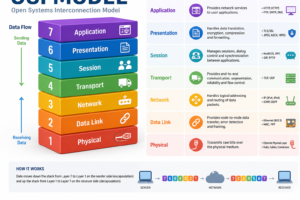
Layer 1- Application layer.- In this layer, we get the user interface, where apps like web browsers or email clients connect to the network.
Layer 2- Presentation layer – This layer translates, encrypts, and compresses data so the application layer can understand it.
Layer 3- Session Layer – This layer manages sessions or connections between computers, opening, closing and managing dialogues.
Layer 4 – Transport Layer – This layer handles end-to-end communication, ensuring data arrives, often using protocols like TCP or UDP.
Layer 5 – Network Layer – This layer decides the best physical path for data using IP addresses to send packets across different networks.
Layer 6 – Data Link Layer – This layer prepares data for the physical network, handling MAC addresses and node-to-node transfer.
Layer 7 – Physical Layer – This layer transmits raw bits (0 &1) over physical hardware, such as cables, connectors, or Wifi.
The OSI model is important because it standardises networking, allowing diverse, multi-vendor systems to communicate seamlessly using a 7-layer framework.
TCP/IP Model Overview
TCP/IP Model is an integrated four-layer model, standardized framework that defines how data is transmitted over networks and the internet, acting as the foundational language for communication between devices.
The Four Layers of the TCP/IP Model are
The Application Layer is the computer networking layer where data is generated and handled, directly interacting with applications. It includes protocols like HTTP, FTP, SMTP, and DNS.
The Transport Layer is a layer that manages end-to-end communication, ensuring data integrity through error control and sequencing. It uses TCP or UDP.
The Internet Layer is the layer that is responsible for logical addressing and routing packets across different networks.
The Network Access layer is the layer that handles physical hardware, MAC addresses, and formats data for the specific physical medium.
Networking Devices you must learn
A router is a networking device that connects multiple networks, such as your home network and the internet and acts as a traffic director, directing data packets to their proper destinations.
A switch is a hardware device that connects, disconnects, or redirects electrical currents or data packets.
A firewall is a network security system that acts as a barrier between trusted internal networks and untrusted external networks, monitoring and controlling traffic based on security rules.
An Access Point is a networking device that creates a wireless local area network, typically in an office or large building, by acting as a bridge between wired Ethernet cables and wireless devices.
A modem is a networking device that acts as a bridge between your home network and your internet service provider.
There are also essential networking skills for beginners to learn, that are subnetting basics, troubleshooting commands and network security basics.
Best Networking Certifications for Beginners
An entry-level networking certification is CCNA, which stands for Cisco Certified Network Associate. It is the best networking course for beginners that covers IP connectivity, network access and IP services, designed for roles like network engineers and administrators.
An Intermediate Level of networking certifications is CCNP, which stands for Cisco Certified Network Professionals, which has two streams: Enterprise and Security. Candidate can choose according to their interest.
Also Check:- https://globeclue.com/complete-aws-solutions-architect-study-notes-to-pass-in-30-days/
The CCNP Enterprise networking certification covers advanced networking technologies, including dual-stack architecture, virtualization, infrastructure, network assurance, security and automation.
The CCNP Security networking certification covers advanced security technologies, including network, cloud, and content security, endpoint protection, secure network access, and VPN.
An Expert-level networking certification is CCIE, which stands for Cisco Certified Internetwork Expert, which has multiple available tracks – CCIE Enterprise Infrastructure, CCIE Enterprise Wireless, CCIE Data Centre, CCIE Security, CCIE Service Provider, CCIE Collaboration, and CCIE Automation.
Globeclue is providing the networking course training online for beginners, in which they cover the basics of computer networking to an advanced level, such as CCNA, CCNP, Fortinet Firewall, Palo Alto Firewall, SDWAN and CCIE, etc., and they are also providing CCNA notes with practicals, which include networking concepts with labs that are designed to be easy to understand.